Impact & Research
Why Early Literacy Matters
Early literacy is one of the strongest predictors of a child’s long-term success. Skills developed in the early elementary years influence academic achievement, confidence, health outcomes, workforce readiness, and lifetime earnings.
When children fall behind early, catching up becomes increasingly difficult. Research shows that access to books, especially books that children can own, is critical to closing this gap.
What Research Tells Us
Research shows that too many children begin their reading journey without the resources they need to thrive.
- 50% of children from low-income communities start first grade up to two years behind their peers
- Nationally, only 35% of fourth-grade students read at or above proficiency
- 61% of low-income families have no books at all in their homes
- A child who struggles with reading at the end of first grade has nearly a 90% chance of remaining a struggling reader by fourth grade
Without support, these early gaps often grow over time. The good news is that research shows a clear and effective way forward: access to books makes a difference.
- A steady supply of new, age-appropriate books can nearly triple children’s interest in reading
- Children who grow up with 20 or more books at home complete an average of three additional years of schooling
- Strong early reading skills are closely linked to graduation, postsecondary success, and long-term opportunity
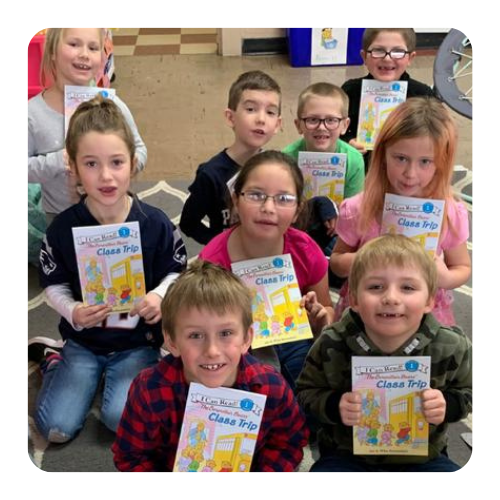
Just as important, ownership matters. Children read more when books belong to them.
- Books children can keep encourage rereading and practice
- Ownership builds pride, confidence, and curiosity
- Families are more likely to read together when books are available at home
- Barriers to learning beyond the classroom are reduced
Literacy impacts more than education. Reading opens doors. Reading improves focus and learning. Reading encourages creativity.
- Strong literacy promotes wellbeing and self-worth.
- Low literacy is associated with many negative health outcomes: increased hospitalizations, difficulty managing chronic conditions and disease, and higher mortality rates.
- Literacy is important to economic development and essential in building skills for our future workforce.
- Because every child deserves to smile and to feel supported.
A Healthier, Stronger Future for Maine
Dirigo Reads applies this research through a simple, scalable model. Today, the program:
- Serves 106 public schools
- Reaches 16 counties across Maine
- Delivers brand-new books every month during the school year
- Remains 100% free for families and schools
Each book placed in a child’s hands is an opportunity, repeated month after month, year after year.